Data Marketing
What to (very) closely watch for Black Friday – updated article
We are meeting again the marketers' need to optimize investments as much as possible, to stay up to date with possibilities, trends, best practices, and solutions.
We have gathered several campaign optimization ideas from the Data Revolt teams for a successful Black Friday.
See below concrete and applicable advice, best practice examples, and experience-based hints for SEO, Content Marketing, Data and Analytics, Direct Marketing, Performance, UX/UI, and Social Media.
Happy Black Friday to everyone!
Search Engine Optimisation
Before Black Friday
→ Ensure the LP is a Hub page: it can include sections from all categories of an ecommerce site, with links to the category, and a carousel or product listing under each category displayed on the page, possibly accompanied by text, a recommended brands area, and a recommended articles area.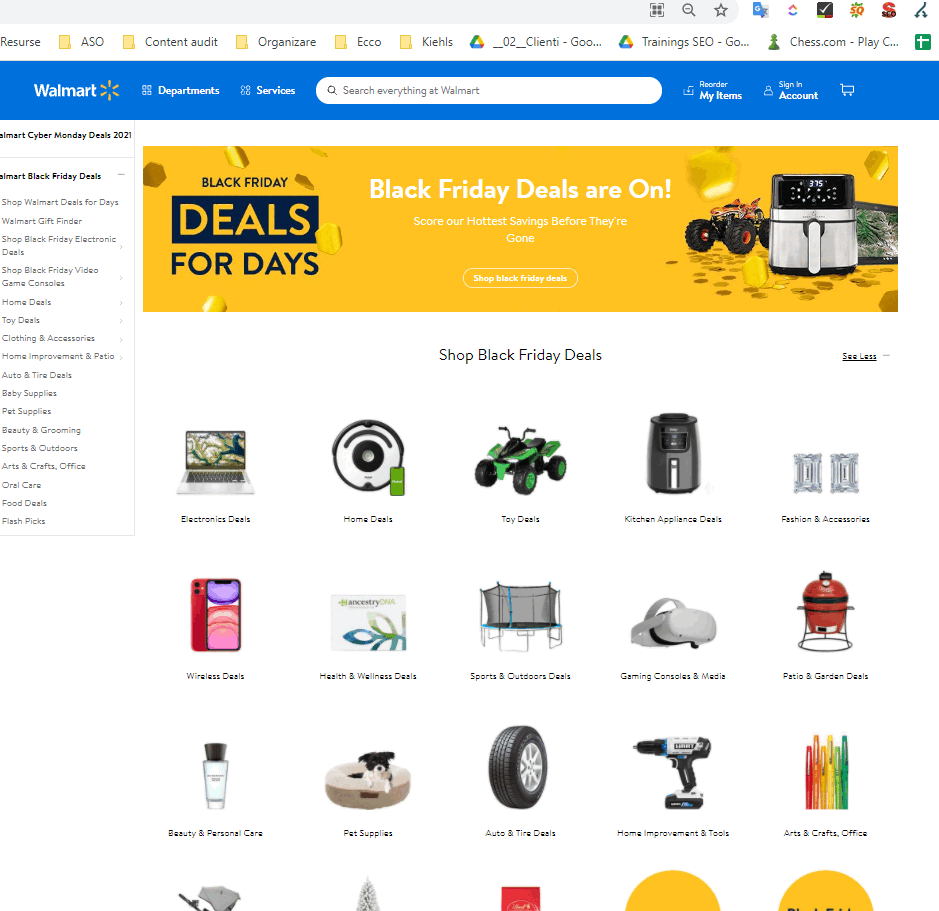
→ Products displayed on the campaign page should not lead to 404 or 301 errors.
→ The loading speed of the landing page must be very good.
→ It should have optimized meta tags.
→ The campaign should be added to the xml sitemap, and when the campaign expires, products should be removed, and only text should be displayed until the following year.
→ We watch for server issues due to intensive access during the Black Friday day/period.
→ Internal linking: the Black Friday landing page should be displayed on all pages of the site (especially in the menu) during the campaign period and in the sitemap.xml.
→ We publish articles with backlinks to the campaign LP the day before the campaign starts to increase the authority of that LP.
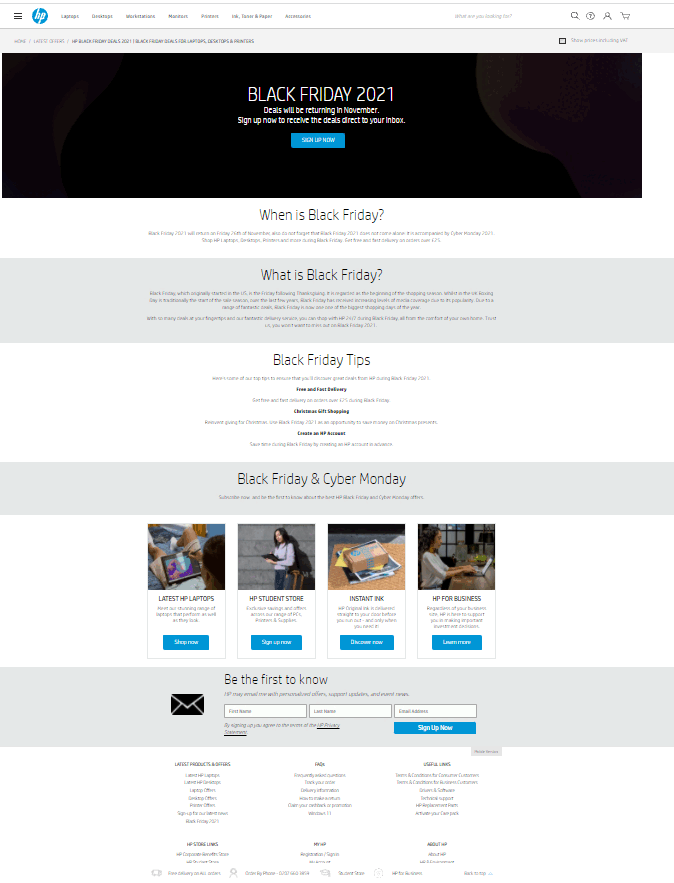
→ We display text on the page and mark it with FAQ structured data, using content such as "When is BF?", "What is BF?".
→ Headline 1, title, meta description, and the menu anchor must contain Black Friday + current year.
→ We use the "Read more" function.
→ We watch the redirect strategy:
- If it is decided to replace the homepage with the Black Friday landing page —> Redirect the teasing landing page to homepage 301.
- If there is a dedicated landing page —> Redirect the homepage to the landing page 302.
Content Marketing
→ Write a <gift/shopping guide> type article and target the keywords with the highest search volumes.
→ The Hub page must contain multiple listicles of the same type (e.g., how to do smart shopping for clothes/appliances/footwear, etc., or the best gift ideas for partners/parents/in-laws, etc.).
→ Use Social Media and DMK to amplify any type of Black Friday-related content published on your site in the preceding period. →
Promote articles and the dedicated Black Friday LP ASAP (before the campaign, as soon as pages are live) through backlinking articles and advertorials.
→ Promote focus product categories (from a business perspective) through third parties, using shoppable content (see more info here: shoppable content).
→ Use a recurring URL and perform a recrawl when the page is live.
→ Don’t forget FAQs in the campaign LP or in the article promoting it – this is where the largest search volumes and, implicitly, the densest slice of organic traffic come from.
→ Communication: use positioning to attract new customers – for example, you can follow the sustainability trend and mention how cleanly you deliver or if you offer recycling/donation alternatives for old items/giving back to the community x percent of profit, etc.
Data
→ We start with a tracking audit and testing the tracking on the Black Friday LP to ensure implementations work unequivocally.
→ We expect a very large volume of data generated in a single day, and to take advantage of this, all campaigns must be UTM-tagged with all 5 parameters: utm_source, utm_medium, utm_campaign, utm_content, utm_term.
This way, we can go very granular later when analyzing campaigns, e.g.
- www.site.ro/?utm_source=paid-channel&utm_medium=cpc&utm_campaign=bf-campaign&utm_content=buy1-get1&utm_term=product
- www.site.ro/?utm_source=paid-channel&utm_medium=cpc&utm_campaign=bf-campaign&utm_content=50%-off&utm_term=product
→ We start with a tracking audit and testing the tracking on the Black Friday LP to ensure implementations work unequivocally.
→ We expect a very large volume of data generated in a single day, and to take advantage of this, all campaigns must be UTM-tagged with all 5 parameters: utm_source, utm_medium, utm_campaign, utm_content, utm_term. This way, we can go very granular later when analyzing campaigns, e.g.
Actions to do before Black Friday:
→ Commercial analysis
→ Setting the pricing strategy
→ Stock predictions
→ Audience creation
→ Real-time dashboard with:
- Traffic sources
- Devices
- Users
- Demographics
- Pageviews
- Javascript errors
- Server response time
- Requests per second
- Detail views
- Add to carts
- Checkouts
- Transactions / Revenue
- User distribution: <homepage/landing> vs vs vs excluding
GTM container optimization:
→ Loading speed: to improve speed, we can drop certain javascript libraries that load pages we don't need – e.g., Hotjar.
→ We want to collect cookies for remarketing actions.
→ Verify the method of collecting traffic sources and UTM parameters for single-page app (SPA) sites.
→ For products sold with samples, we recommend including samples in remarketing campaigns along with the main products.
User parameter collection:
→ We recommend collecting available user parameters based on the business segment to group and analyze behavioral patterns and preferences for each group.
→ Analyze last year's buying preferences for each user cluster, taking into account available stock and the current marketing strategy.
→ Use user parameters automatically collected by GA (inte
GA4 Insights:
- → Analyze the percentage of first-time buyers and the percentage of users likely to purchase products in the next 7 days, using GA4's machine learning capabilities.
- → Create predictive and standard audiences in advance so they are populated with users before the Black Friday launch date and build a result-oriented marketing strategy.

Direct Marketing
→ Divide the Black Friday campaign into 3 distinct stages:
Before Black Friday: You must set up strategies to activate latent users, generate new leads, and create buzz to anticipate the event for active users.
During Black Friday: Focus on launching the campaign with product recommendations, a few reminders, the best brands, products, and of course, discounts.
After Black Friday
→ Ideally, set up a campaign after Black Friday with remaining discounts for those who arrived late or an exclusive voucher to be used before the winter holidays.
→ Don't panic if you see a drop in the number of transactions before Black Friday. Your customers are saving their budget for Friday.
→ If you don't intend to ruin your email open rate and click rate, choose to communicate on Black Friday only with the segment of subscribers who usually interact. For the latent ones, see point 1 – if you can't activate them, well, Sayonara!
→ Try to send the Black Friday email around 7:30 AM. You will surely be among the first.
→ Ensure the main selling points are visible: free shipping, loyalty points, bonuses, anything that can reduce customers' decision time.
→ One of the mechanics that proved successful during Black Friday was: buy now, pay later.
→ If you want a Black Friday campaign for the record books, send all automated emails with specific themes: make it Black and Friday and discounts everywhere!
→ Plan the communication frequency and themes in advance to avoid excessive communication or, conversely, insufficient communication.
→ Take into account the reduction of promotional campaigns and vouchers in the period leading up to Black Friday.
→ Depending on the type of campaign (general discount applied to the entire range, or advent calendar type), email frequency should not exceed one email/day during Black Friday. We must avoid annoying subscribers, especially during this period.
→ Segmentation is the key to successful Black Friday communication. Ideally, we should communicate differently with each major customer segment:* Inactivi
- Inactive
- Active
- VIPs
- Single-purchase customers
- Those who don't seem to return to the site
Example: Remind inactive customers why they should return, while offering VIPs sneak peeks to build anticipation. → Define campaigns that prepare customers for Black Friday, but also campaigns for after Black Friday. → Develop content that is as attractive and different as possible. Customers' inboxes will be full of the same Black Friday messages, so it's important to dare to have unconventional subjects, GIFs, and creative phrasing.
Performance marketing
Înaintea perioadei de Black Friday
→ Define campaigns with a newsletter subscription objective and send "push notifications."
→ Focus on obtaining micro-conversions
→ Configure audiences – ensure we have relevant audiences for Black Friday identified so we can use them in campaigns.
→ Define audiences to capture and isolate users who enter the site following Black Friday campaigns to use them for subsequent campaigns (Cyber Monday, Christmas, spring-sale, etc.). →
Analyze the product categories that will be part of the Black Friday promotion.
→ Establish a supplementary budget for the Black Friday period.
→ Establish the budget split by campaign type to ensure visibility and performance: awareness / transactions. → Clearly establish the start date for the Black Friday day/period.
- Note: This (correlated with the budget split) helps in gradually increasing budgets in campaigns with profit-focused bidding strategies to avoid sudden budget increases that could destabilize the campaign.
→ Create Black Friday ads for search campaigns (communicating Black Friday, discount values, product categories in the promotion, etc.) and set rules to start them on the Black Friday day/period. At the same time, be careful to stop ongoing ads (those without a Black Friday message).
→ Define teasing campaigns with an awareness component (video, display, discovery, etc.) to create expectations and announce upcoming offers.
During the Black Friday period
→ Check campaign budgets multiple times a day – sometimes a campaign can consume the daily budget in a few hours due to high search volume and rising costs.
→ R